Building a job-winning data science portfolio requires more than following basic, overused tutorials like the Titanic dataset. It demands projects that solve real business problems. Bridging the gap between raw datasets and actionable strategy is exactly what tech recruiters and hiring managers look for in today’s competitive job market.
When making the leap from an engineering background into the world of artificial intelligence and analytics, I quickly realized that theoretical knowledge isn’t enough. From engineering scalable machine learning pipelines to predicting complex market trends, the real value of a data scientist lies in applied problem-solving.
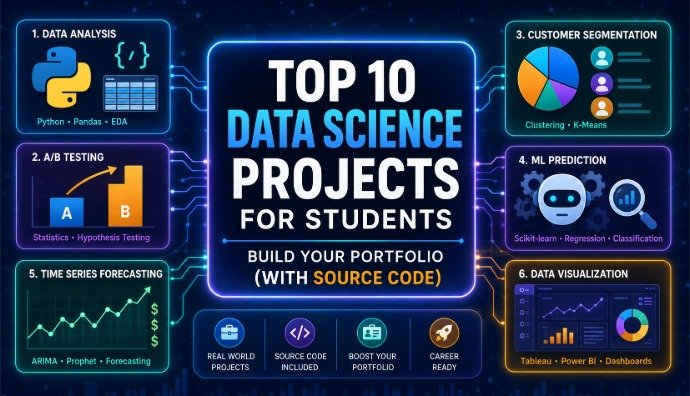
In this guide, we will break down the top 10 data science projects for students that not only demonstrate technical proficiency but also highlight strong business acumen. Each project includes real-world methodologies, the skills you will learn, and the exact GitHub repositories you can reference to build your own.
Why a Portfolio is Your Best Data Science Resume
Certificates are great, but a well-documented GitHub repository speaks louder to hiring managers. A strong portfolio proves that you can handle the messy reality of raw data. It shows you know how to write clean code, handle missing values, and translate statistical outputs into business strategies.
If you are looking to make a career pivot, having a library of completed projects is non-negotiable. For more insights on making this shift, check out my comprehensive guide on How to Transition from Engineering to Data Science (2026 Guide).
Let’s dive into the projects that will make your resume stand out
Top 10 Data Science Projects for Students to Build in 2026
1. Automobile Customer Analytics & Segmentation
The Problem: Marketing budgets are constantly wasted when campaigns target the wrong demographic.
The Solution: An end-to-end Exploratory Data Analysis (EDA) and segmentation project identifying purchase patterns and high-value customer segments for an automobile company.
Key Skills Learned: EDA, Python (Pandas, Seaborn), Univariate & Bivariate Analysis, Correlation Analysis.
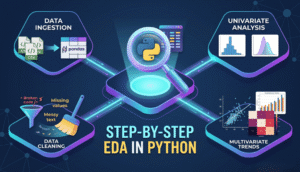
💡 Pro Tip: Don’t just find the correlations; explain them. For example, identifying that married, loan-free customers are the primary segment provides a direct, actionable business recommendation to the marketing team. If you are new to this phase of data science, review this Step-by-Step Exploratory Data Analysis (EDA) in Python tutorial to get started.
🔗 Project Reference: Automobile Sales Data Insights
2. E-news Express A/B Testing (Inferential Statistics)
The Problem: Digital publishers need to know if a website redesign actually increases user engagement or if it’s just random chance.
The Solution: Conducting robust hypothesis testing (Welch’s t-test, Z-test, ANOVA) to evaluate conversion rates for a digital landing page.
Key Skills Learned: A/B Testing, Bayesian Probability, SciPy, Statistical Summarization.
Real Example: Statistically confirming a 33% increase in user engagement through a redesigned page proves to recruiters that you can back up digital marketing decisions with hard math.
🔗 Project Reference: Marketing Insights & Inferential Analysis
3. Hotel Booking Cancellation Prediction
The Problem: Last-minute cancellations result in massive revenue losses and operational chaos for the hospitality industry.
The Solution: A predictive classification system that identifies high-risk bookings using Machine Learning models like Logistic Regression, KNN, and Decision Trees.
Key Skills Learned: Classification, Feature Engineering, VIF Multicollinearity Treatment, ROC-AUC Optimization.
🤖 AI Insight: Hyperparameter tuning (like decision tree pre-pruning) is what separates a beginner model from a production-ready system. Always tune for business-specific metrics like Recall to catch the maximum number of cancellations. To see the full breakdown of how I built this, read How I Predicted Hotel Booking Cancellation using Machine Learning Models.
🔗 Project Reference: Hotel Booking Cancellation Prediction
4. U.S. Visa Approval Classification
The Problem: Processing massive amounts of immigration and workforce data manually is inefficient and prone to bias.
The Solution: An ensemble ML model that predicts U.S. visa case outcomes (Certified vs. Denied) using applicant and employer attributes.
Key Skills Learned: Ensemble Methods (Random Forest, Gradient Boosting, XGBoost), SMOTE for Class Imbalance.
Quick Try-It Guide: When dealing with highly imbalanced datasets (like approved vs. denied cases), try implementing SMOTE oversampling before training your baseline model. It instantly boosts minority class detection. You can learn more about implementing these models in the official Scikit-Learn documentation.
🔗 Project Reference: Visa Approval Classification
5. Credit Card Customer Segmentation (Unsupervised ML)
The Problem: Banks struggle to personalize services for thousands of distinct credit card users with unique spending habits.
The Solution: Segmenting customers based on behavioral data using K-Means and Hierarchical Clustering to guide targeted marketing.
Key Skills Learned: K-Means Clustering, Agglomerative Clustering, Silhouette Analysis, Dendrograms.
💡 Pro Tip: Use the Elbow Method and Silhouette Coefficient plots to statistically justify your chosen number of clusters. Recruiters love to see mathematical validation behind your architecture choices.
🔗 Project Reference: Credit Card Customer Segmentation
6. Time Series Wine Sales Forecasting
The Problem: Supply chain bottlenecks and inventory stockouts cripple retail revenue during peak holiday seasons.
The Solution: Predicting the next 12 months of sales demand using historical time-series data to optimize inventory.
Key Skills Learned: ARIMA, SARIMAX, Exponential Smoothing, Seasonal Decomposition, Dickey-Fuller Stationarity.
Real Example: Decomposing 15 years of historical sales data into trend, seasonality, and noise helps executives formulate specific strategies to prevent stockouts and maximize profit margins.
🔗 Project Reference: Time Series Wine Sales Forecasting
7. Car Insurance Claims Analysis Dashboard
The Problem: Massive, unstructured claims data makes it difficult for insurance adjusters to spot fraud or high-risk demographic segments quickly.
The Solution: An interactive visual dashboard uncovering risk patterns across age, income, and vehicle type.
Key Skills Learned: Tableau, Data Storytelling, KPI Design, Parameter Controls.
🤖 AI Insight: Business Intelligence (BI) tools paired with automated data cleaning pipelines create the perfect harmony between backend data engineering and frontend executive storytelling.
🔗 Project Reference: Car Insurance Claims Dashboard
8. Cafe Sales EDA & Market Basket Analysis
The Problem: Restaurants frequently leave money on the table by failing to cross-sell items that naturally pair together.
The Solution: Discovering hidden customer purchase patterns and profitable combos using Python (EDA) and KNIME (Apriori algorithm).
Key Skills Learned: Market Basket Analysis, Association Rule Mining, KNIME Automation, POS Data Analysis.
Quick Try-It Guide: Filter your association rules by a Lift > 1 metric. If an item combination has a high lift and high confidence, it is the perfect candidate for a POS cross-sell prompt!
🔗 Project Reference: Cafe Sales & Revenue Optimization
9. Finance Risk Analytics & Credit Default Prediction
The Problem: Approving high-risk corporate loans and ignoring market volatility leads to massive institutional losses.
The Solution: A dual-part project featuring corporate financial default prediction alongside Indian equity portfolio risk analysis.
Key Skills Learned: Credit Risk Modeling, Portfolio Analysis, KNN Imputation, Scikit-learn.
💡 Pro Tip: In finance, missing data is rarely random. Utilizing advanced techniques like KNN imputation preserves crucial rows of defaulter records that traditional “dropping” methods would carelessly erase.
🔗 Project Reference: Finance & Retail Analytics
10. BCCI Cricket Win Prediction (Capstone Strategy)
The Problem: Sports teams heavily rely on gut feelings rather than data to determine match tactics and player selections.
The Solution: An end-to-end supervised machine learning pipeline predicting match outcomes to optimize team selection and tactical strategy.
Key Skills Learned: GridSearchCV Hyperparameter Tuning, Multi-model Comparison (KNN, Naive Bayes, Decision Tree), Outlier Capping.
Real Example: Translating algorithm feature importances into specific, opponent-unique tactical recommendations shows you know how to turn a Jupyter Notebook output into a board-level strategy.
🔗 Project Reference: Cricket Win Prediction ML
Frequently Asked Questions (FAQs)~
Q: What is a good data science project for a beginner?
A strong beginner project involves Exploratory Data Analysis (EDA) on a structured dataset. For example, analyzing automobile customer data to find segmentation patterns is an excellent way to practice Python (Pandas/Seaborn) without needing complex machine learning models right away.
Q: Where can I find datasets for my data science projects?
You can find high-quality, open-source datasets on platforms like Kaggle, the UCI Machine Learning Repository, and Google Dataset Search. Real-world, messy data is always best for practicing your cleaning skills.
Q: Do I need a portfolio to get a data science job?
Absolutely. Tech recruiters look for deployed projects and clean GitHub repositories to verify your practical skills. Focus on projects that solve clear business problems rather than just copying standard academic tutorials.
Q: Which programming language is best for data science projects?
Python is the current industry standard due to its extensive libraries (Scikit-learn, Pandas, NumPy) and versatility. SQL is also mandatory for database management and data extraction.
Conclusion
Conclusion
Building a standout data science portfolio isn’t about how many complex algorithms you can code from memory—it’s about demonstrating how you use data to solve pressing business challenges. Whether you are forecasting wine sales, segmenting banking customers, or predicting sports outcomes, the data science projects for students listed above will prove your readiness for the industry.
Stop getting stuck in “tutorial hell.” Pick a dataset, define a business problem, and start building your repository today.
💡 Want to explore more AI tools and automation tutorials? Visit AnalyticsWithNabaN for hands-on learning and resources.
Explore more AI tools, data science tutorials, and automation guides at AnalyticsWithNabaN Stay ahead in the tech-driven world!