If you are an engineer considering a career pivot, you have probably faced the “sunk cost fallacy.” It is the nagging fear that you are throwing away years of demanding education or tough floor experience just to start from scratch.
But the 2026 tech market is not looking for standard, copy-paste coders. It is looking for problem-solvers who can leverage AI, clean up messy data, and drive actual business decisions.
I know this firsthand. When I was working as a Production Planning Engineer, my days were spent leading cross-functional teams to optimize manufacturing efficiency. I eventually realized that identifying a bottleneck on the factory floor uses the exact same analytical muscle required to deploy an enterprise AI solution.
In this guide, I will show you how to transition from engineering to data science in 2026 by mapping your existing mindset directly to modern tech stacks. You don’t need to start over; you just need to reframe your skills.
Why Engineers Are Secretly Built for Data Science
You Already Think in Algorithms
Engineering—whether electrical, mechanical, or industrial—is fundamentally about system design, navigating constraints, and constant optimization.
This is exactly how machine learning works. When you train an AI model, you are setting parameters, minimizing errors, and optimizing for the best possible outcome. You already have the mathematical foundation and logical framing; you just need to learn the new syntax.
The Cross-Functional Advantage
Data science does not exist in a vacuum. A model is useless if the business cannot understand or implement it.
Engineers are inherently used to translating technical constraints to non-technical stakeholders. If you have ever had to explain a supply chain delay to a floor manager or a budget constraint to an executive, you already possess one of the most sought-after soft skills in the data industry.
Real Example: During my time in Production Planning and Control, I frequently dealt with misaligned schedules and resource bottlenecks. Diagnosing these operational blockages is conceptually identical to diagnosing “data drift” (when a model’s accuracy degrades over time) in a machine learning pipeline. The root cause analysis is the same.
The 2026 Data Science Tech Stack (What You Actually Need)
Forget the outdated advice from 2020 that told you to learn every single programming language from scratch. To make a successful career change to data science today, you need to focus on what drives actual value.
The Non-Negotiables
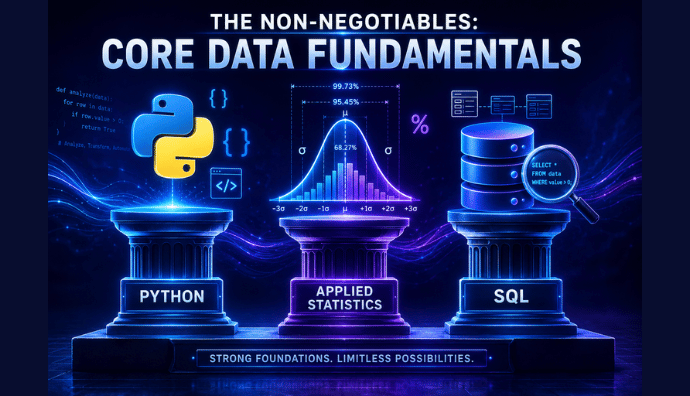
You cannot skip the fundamentals. Before touching complex AI, you must understand the core language of data.
Python: The undisputed industry standard for scripting, modeling, and automation.
SQL: Essential for extracting and structuring raw data from massive databases.
Applied Statistics: You need to understand probability, distributions, and A/B testing to ensure your models are actually valid.
The AI Accelerators (Agentic AI & AutoML)
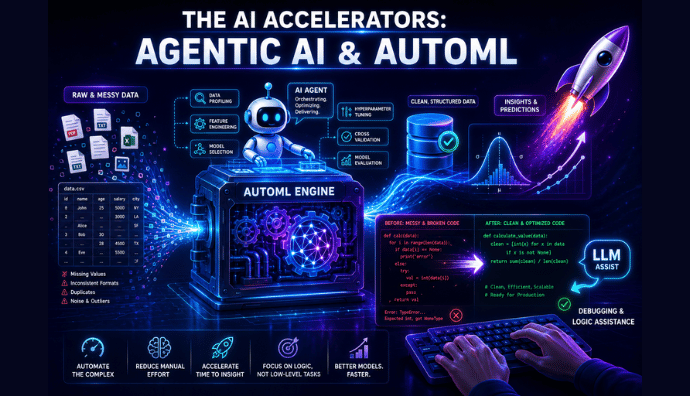
In 2026, engineers do not need to write every line of predictive model code manually. The modern data science roadmap heavily features AI workflow automation.
Concepts like Agentic AI (using autonomous agents to execute multi-step tasks) and AutoML platforms streamline data cleaning and model selection. Tools like Make.com and cloud-based AutoML allow you to deploy solutions much faster.
Bridging the Gap: A 6-Month Transition Roadmap
Making the transition from engineering to data science requires structure. Here is a realistic, no-fluff 6-month roadmap.
Months 1-2: Data Wrangling & SQL
Start by learning how to extract and clean data. Master SQL window functions, joins, and aggregations. Learn how to pull data from messy sources and structure it for analysis.
Months 3-4: EDA & Visualization
This is where you learn to tell the story of the data. Dive deeply into Python libraries like Pandas for data manipulation and Seaborn for visualization.
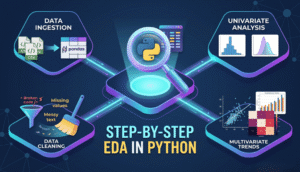
Need a head start? Check out our complete Step-by-Step Exploratory Data Analysis (EDA) in Python guide.
Months 5-6: Predictive Modeling & Deployment
Move from analyzing the past to predicting the future. Focus on practical Machine Learning models (Linear Regression, Random Forests, XGBoost). Learn how to deploy your models using platforms like Microsoft Azure or AWS.
Pro Tip: Avoid “tutorial hell.” Watching videos will only get you so far. Spend 30% of your time learning theory and 70% of your time building with messy, real-world datasets.
Building a Portfolio That Speaks to Tech Recruiters
Quality Over Quantity
Recruiters do not want to see ten basic, identical Jupyter notebooks cloned from a tutorial. They want to see that you can solve business problems.
Three end-to-end, deployed projects will always beat a folder full of basic scripts. Show that you can collect data, build a model, and deploy it to a live environment.
I enjoy building useful and engaging digital experiences. If you’re interested in seeing more of my work, you can explore my portfolio, where I’ve highlighted my best projects, skills, and achievements.
Quick Try-It Guide:
Go to Kaggle and find a dataset related to your current engineering domain (e.g., supply chain logistics or energy consumption).
Run a basic Exploratory Data Analysis (EDA) to find three actionable insights.
Write a brief report on how a business could save money using those insights. You have just completed your first project phase!
FAQs ~
Do I need a computer science degree to become a data scientist?
No. Engineering degrees (electrical, mechanical, industrial) provide the rigorous mathematical foundation and logical problem-solving skills required to excel in data science.
How long does it take to transition from engineering to data science?
With a structured learning path and consistent effort (10–15 hours a week), most engineers can learn the required tools and become job-ready in 6 to 9 months.
Is data science still a good career in 2026 with the rise of AI?
Yes. While AI automates basic coding and syntax generation, the demand for professionals who can design data systems, interpret complex results, and align AI with business goals is higher than ever.
What programming language should I learn first?
Python. It is the core language for machine learning, data manipulation, and integrating with modern AI tools.
Conclusion
Transitioning from engineering to data science is not about abandoning your past experience; it is about upgrading your toolkit. Your background in optimizing systems, managing constraints, and leading cross-functional teams is a massive advantage in the tech world.
Follow the 6-month roadmap, focus on building high-quality portfolio projects, and leverage AI to accelerate your learning. You are already built for this.
💡 Want to explore more AI tools and automation tutorials? Visit AnalyticsWithNabaN for hands-on learning and resources. Stay ahead in the tech-driven world!
You may also like to read ~