We’ve spent the last few years learning how to talk to AI. Now, AI is finally starting to do the talking—and the working—for us.
If you are a tech professional or student, you have likely experienced “prompt fatigue.” You ask ChatGPT to write a Python script, it gives you a snippet, and you still have to copy, paste, test, debug, and deploy it yourself. But what if the AI could handle that entire pipeline autonomously?
Early in my career, I worked in production planning and control, leading cross-functional engineering teams to optimize manufacturing efficiency. When I transitioned into data science, I quickly realized that building scalable data pipelines requires that exact same level of coordination. Today, instead of managing human teams to pass tasks back and forth, we are moving toward managing digital teams.
That is the core promise of Agentic AI.
In this guide, we will break down what Agentic AI is, how autonomous agents work under the hood, and how this technology is reshaping the future of work and online learning.
The Multi-Agent System: Why One Agent Isn't Enough
In manufacturing or software development, you rarely have one person doing everything. You have specialists. Agentic AI workflow automation follows the same logic.
Breaking Down Complex Tasks
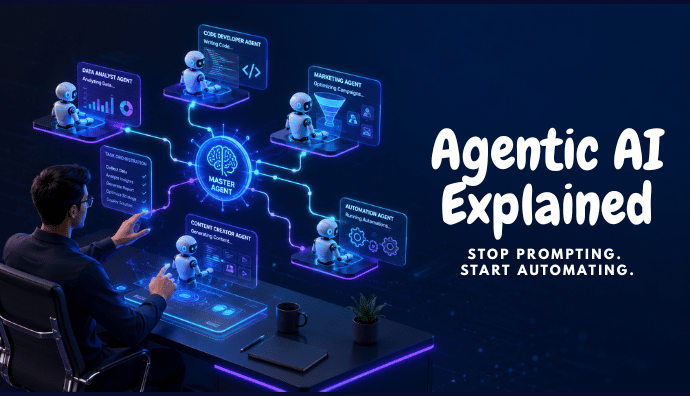
Instead of relying on a single AI to write code, test it, and deploy it, developers are building multi-agent systems. In these setups, multiple specialized agents collaborate. For example, a “Research Agent” gathers data, hands it off to a “Coding Agent” to build a model, and finally passes it to a “QA Agent” to check for errors before anything is published.
Real Example: The Autonomous Data Scientist
Imagine you want to perform an Exploratory Data Analysis (EDA) on a messy CSV file, like a food delivery trends dataset.
Without Agentic AI, you write the Python code, import Pandas and Seaborn, clean the null values, and generate the charts yourself. With an autonomous AI agent, you simply upload the dataset and say, “Analyze this data for ordering trends and output a summary report.” The agent writes the code, executes it in a secure environment, spots an error in the dataset, rewrites its own code to fix the error, and hands you the final visual report.
If you want to build projects like this yourself, check out our guide on Data Science Project Ideas to start building your portfolio.
How Autonomous Agents Actually Work (Under the Hood)
Autonomous agents are not magic; they are built on a very specific technical architecture. An effective AI agent relies on three main components:
The Brain (LLMs): Large Language Models (like GPT-4 or Gemini) power the agent’s reasoning capabilities, allowing it to understand the goal and plan out a sequence of actions.
Memory Modules: Agents use short-term memory to keep track of their current progress and long-term memory (often via vector databases) to learn from past executions and maintain context.
Tools & APIs: This is where the magic happens. Through protocols like function calling, an agent can securely connect to external tools. It can browse the web, write and execute code in a terminal, or push a file to a cloud server.
The Multi-Agent System: Why One Agent Isn't Enough
In manufacturing or software development, you rarely have one person doing everything. You have specialists. Agentic AI workflow automation follows the same logic.
Breaking Down Complex Tasks
Instead of relying on a single AI to write code, test it, and deploy it, developers are building multi-agent systems. In these setups, multiple specialized agents collaborate. For example, a “Research Agent” gathers data, hands it off to a “Coding Agent” to build a model, and finally passes it to a “QA Agent” to check for errors before anything is published.
Real Example: The Autonomous Data Scientist
Imagine you want to perform an Exploratory Data Analysis (EDA) on a messy CSV file, like a food delivery trends dataset.
Without Agentic AI, you write the Python code, import Pandas and Seaborn, clean the null values, and generate the charts yourself. With an autonomous AI agent, you simply upload the dataset and say, “Analyze this data for ordering trends and output a summary report.” The agent writes the code, executes it in a secure environment, spots an error in the dataset, rewrites its own code to fix the error, and hands you the final visual report.
If you want to build projects like this yourself, check out our guide on Data Science Project Ideas to start building your portfolio.
How to Build Your First AI Agent (Quick Try-It Guide)
You don’t need a PhD in machine learning to start building autonomous agents.
Tools to Get Started Today
Several open-source frameworks and no-code tools have made agent creation accessible:
LangChain & CrewAI: Fantastic Python frameworks for building multi-agent systems.
AutoGPT: One of the earliest and most popular autonomous agents.
Zapier & Make.com: Excellent no-code platforms for creating automated agentic workflows that trigger actions across hundreds of apps.
A 3-Step Setup for Beginners
Want to try it yourself? Follow this simple loop:
Define the Objective: Give your agent a clear, narrow goal (e.g., “Research the top 5 competitors in my niche”).
Equip the Agent: Give it access to a web search tool and a document writer.
Run and Monitor: Start the script and watch the terminal. You will see the agent “think,” plan its search queries, read the results, and write the summary autonomously.
(Need to brush up on your coding skills first? Start with our guide to Learn Python for AI and Automation.)
The Risks: Context Rot and AI Governance
To be clear, Agentic AI is not perfect yet. Trustworthiness requires understanding the technology’s limits.
Why Agents Fail (And How to Fix It)
Context Rot: During long, complex tasks, an agent might “forget” its original instructions and go off on an unhelpful tangent.
Hallucinations: Sometimes an agent might confidently use a tool incorrectly, or invent a software package that doesn’t exist.
Because of these risks, production-level AI relies on Human-in-the-Loop (HITL) governance. The AI can do 90% of the work, but a human must review and click “Approve” before the agent is allowed to execute high-stakes actions like dropping a database table or spending an ad budget.
How Agentic AI is Reshaping Careers (For Professionals and Students)
The rise of autonomous agents is causing a massive shift in how we approach technical skills and online learning.
For Tech Professionals: The Hybrid Workforce
Will AI take your job? Probably not. But someone managing an AI agent might. Tech professionals—especially in software engineering and data science—are transitioning from “creators” to “orchestrators.”
Instead of writing boilerplate code, your value will come from designing system architectures, defining business logic, and overseeing the multi-agent systems that do the heavy lifting. According to experts featured on the Google AI Blog, human-AI collaboration is the defining metric for future productivity.
For Students: Learning in the Agentic Era
If you are a student learning to code today, do not just memorize syntax. Focus on systems thinking.
Pro Tip: Learn how APIs connect, how databases store information, and how to use no-code automation platforms like Make.com or Zapier. Understanding how to connect systems will make you an incredible AI orchestrator.
FAQs ~
What is an example of Agentic AI?
An autonomous coding assistant is a great example. Instead of just suggesting code (like GitHub Copilot), an agentic tool will write the code, run it, find bugs, fix them, and deploy the working software entirely on its own.
Will autonomous agents replace software engineers?
No, but they will evolve the role. Engineers will shift from manually writing scripts to orchestrating and managing teams of specialized AI agents.
How is Agentic AI different from ChatGPT?
ChatGPT is reactive; it waits for your prompt. Agentic AI is proactive; it takes a broad goal, makes a plan, uses tools (like web browsers), and executes steps until the goal is completed.
Are AI agents safe to use for business?
Yes, provided they are built with safeguards. Most businesses use Human-in-the-Loop (HITL) systems, meaning the agent cannot finalize important actions (like moving money or deleting data) without human approval.
Conclusion
Agentic AI represents a massive leap forward. We are moving from AI tools that merely talk to AI teammates that actually do.
Transitioning into this new era requires a shift in mindset. Whether you are automating simple workflows with no-code tools or coding complex multi-agent systems in Python, the ability to manage and orchestrate AI is quickly becoming the most valuable skill in the tech industry. Start small, build an agent to automate a simple daily task, and watch how it transforms your workflow.
💡 Want to explore more AI tools and automation tutorials? Visit AnalyticsWithNabaN for hands-on learning and resources.
Explore more AI tools, data science tutorials, and automation guides at analyticswithnaban.com. Stay ahead in the tech-driven world!